On December 5, 2025, the 13th Academic Symposium of the Frontier Forum on Elemento-Organic Chemistry was successfully held at the State Key Laboratory of Elemento-Organic Chemistry Nankai University. With the theme " Elemento-Organic Functional Materials ", this session featured keynote lectures by four preeminent scholars in the field, facilitating in-depth discussions on cutting-edge research advances and interdisciplinary trends. The event attracted active participation from faculty members, students, and leading experts across academia. The opening ceremony was chaired by Researcher Xiaoye Wang from the State Key Laboratory.
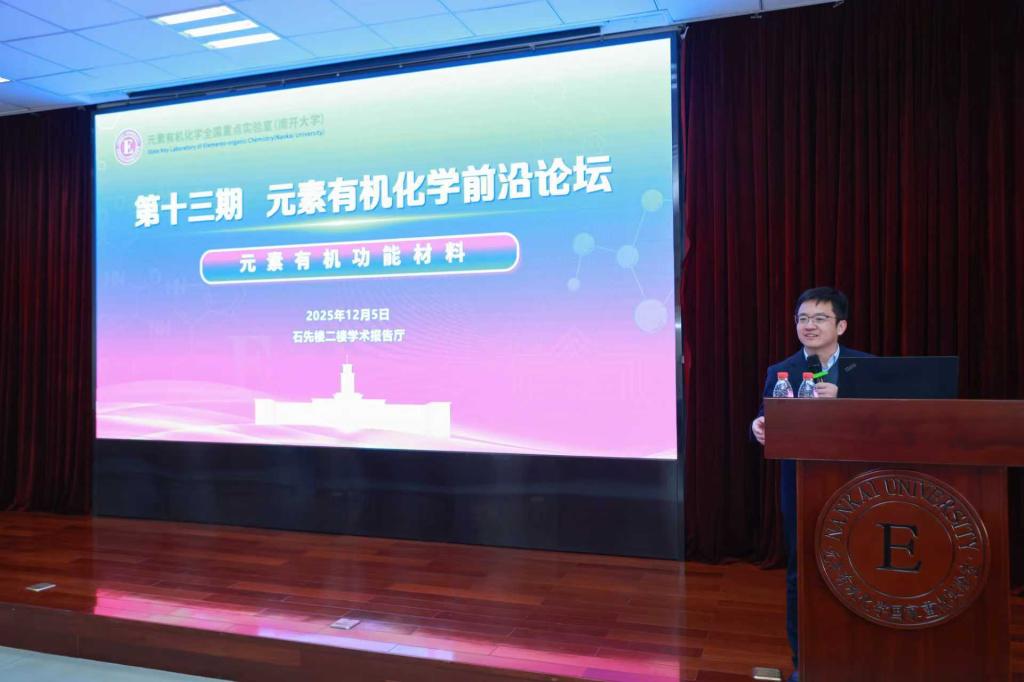
Professor Fangyi Cheng, Dean of the College of Chemistry at Nankai University, attended the forum and delivered a speech. He reviewed the forum’s development since its establishment in 2022 and highlighted the significant potential of element-organic functional materials in fields such as optoelectronic information, new energy, and biomedicine, emphasizing their notable academic value and application prospects. He expressed his hope that the attending faculty and students would seize the opportunity presented by this conference to inspire research ideas, spark innovative thinking, and promote interdisciplinary collaboration.
During the conference session, Professor Qingdong Zheng from Nanjing University delivered a presentation titled "Ladder-Type Fused-Ring Organic Photovoltaic Materials and Devices." He systematically introduced the design of ladder-type optoelectronic materials based on the D-π-A structure and their applications in organic solar cells. He particularly highlighted the research achievements of the "M" series acceptor materials in enhancing device efficiency and thermal stability.
Professor Qian Peng from the University of Chinese Academy of Sciences focused on the topic "Theoretical Design and Screening of OLED Luminescent Materials." Starting from theoretical calculations and molecular design, he elaborated on the application of excited-state rate theory models and high-throughput screening platforms. He showcased innovative progress in luminescent material systems such as AIE, TADF, and hot exciton materials.
Professor Chuandong Dou from Jilin University delivered a presentation titled "Boron-Containing Functional Molecular Carbon Materials." He systematically introduced strategies for creating boron-doped functional molecular carbon systems with novel optoelectronic and magnetic properties. These strategies include precisely incorporating boron atoms to modulate conjugated backbone structures, constructing boron-nitrogen coordination bonds, and designing open-shell electronic configurations.
Professor Yaowen Li from Soochow University delivered a presentation titled "Flexible Organic Solar Cells and Their Modules." He focused on sharing research breakthroughs in key areas such as flexible transparent electrodes, active layer morphology control, and device encapsulation. Furthermore, he outlined the development pathways and challenges for creating high-performance, bend-resistant photovoltaic devices aimed at applications in fields like wearable electronics.
After each presentation, the attending faculty and students engaged in lively discussions with the speakers on key issues such as precise material design, synthesis strategies, and device stability. The frequent on-site interactions fostered a vibrant and intellectually stimulating academic atmosphere.
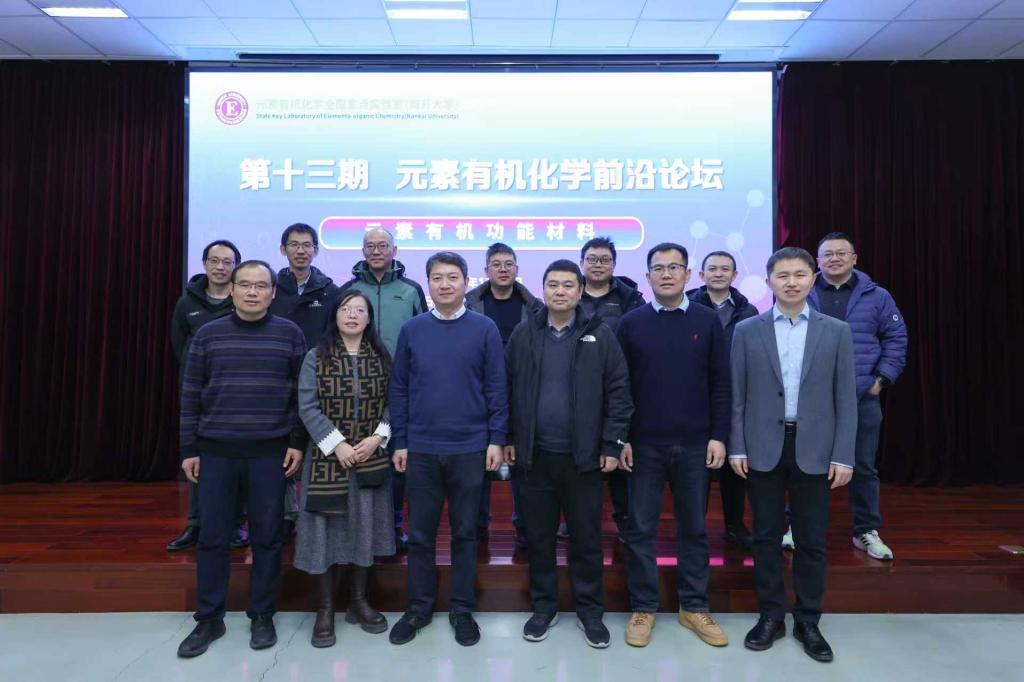
It is reported that since 2022, in order to strengthen in-depth exchanges between the faculty and students of the key laboratory and experts and scholars both domestically and internationally, and to enhance the disciplinary influence of " Elemento-Organic Chemistry (EOC)," the laboratory has launched the "Frontiers in Elemento-Organic Chemistry" series of small-scale seminars. This branded event is characterized by its "small scale, deep focus, and high interaction," with each session centered around a cutting-edge topic and featuring 2-5 top scholars from home and abroad sharing their latest research findings. Over the past three years, 12 sessions have been successfully held, covering various fields such as main-group element chemistry, organometallic complex chemistry, catalysis, and organic synthesis. It has become an important platform for promoting interdisciplinary integration and inspiring innovative ideas.

