Ubiquitination is among the most important and complex post-translational modifications in eukaryotic cells. Ubiquitin is a highly conserved 76-amino-acid protein whose C-terminus can be linked, via an isopeptide or peptide bond, to any of the seven lysine residues (K6, K11, K27, K29, K33, K48, K63) or the N-terminus of another ubiquitin, producing chains of different lengths, linkage types, and topologies. These structurally diverse chains carry distinct biological information and are regarded as an important "signal-coding language" of the cell, participating in protein degradation, DNA damage repair, innate immunity, autophagy, and other key processes. How different ubiquitin chains achieve precise signal transmission through their distinct structures and dynamics, and the structure-activity relationships behind this, remain incompletely understood.
Because natural enzymatic ubiquitination systems suffer from substrate selectivity, limited chain-type control, and product heterogeneity, the efficient preparation of homogeneous ubiquitin chains with defined linkage type, length, and labeling sites remains a major challenge in ubiquitin chemistry and structural biology. Chemical synthesis and semisynthesis have opened new routes to homogeneous chains, and researchers have developed various methods based on chemical ligation, enzyme-assisted assembly, and genetic code expansion, but these strategies are often limited by harsh conditions, tedious procedures, and restricted chain-elongation direction. A mild, efficient, and modular assembly method is therefore highly desirable for studying ubiquitin chain structure and function. Moreover, ubiquitin chains in solution usually exist as a dynamic equilibrium of multiple conformations, which static methods such as crystallography cannot fully capture, limiting mechanistic understanding of ubiquitin signaling.
Recently, the research group of Professor Xuncheng Su at Nankai University published a paper in the Journal of the American Chemical Society reporting an enzyme-controlled protecting-group-assisted cascade bioconjugation strategy that achieves controlled, directional, and modular assembly of ubiquitin chains. The work provides a new technical platform for high-resolution dissection of the structures, dynamics, and molecular recognition of complex ubiquitin chains by NMR and EPR, and it gives an initial account of how ubiquitin chain conformations behave dynamically inside and outside cells.
In earlier work, the team had developed a series of pyridine-based thiol-modification reagents. By tuning the electronic effects on the pyridine skeleton, they created a family of highly reactive 4-phenylsulfonylpyridine thiol-coupling reagents, laying the chemical foundation for kinetically controlled sequential thiol coupling (Chem. Commun. 2015, 51, 2824-2827; Acc. Chem. Res. 2019, 52, 1675-1686; Chem. Commun. 2016, 52, 11535-11538). In the present work, they systematically optimized the reactions of these bifunctional thiol-coupling reagents with ubiquitin cysteine mutants and selected the reagent with the highest efficiency and selectivity, 5-fluoro-4-(phenylsulfonyl)pyridine-2-carbonitrile (FPPN). Combined with their recently established strategy of transthiolase-catalyzed reversible protection and deprotection of protein C-terminal cysteines, this enabled the stepwise, precise, and efficient assembly of homotypic, mixed, and branched ubiquitin chains (Figure 1).
The platform combines high assembly efficiency, mild conditions, and good compatibility with functionalization: the ubiquitin building blocks are conveniently obtained by recombinant expression, and stable isotopes, spin labels, and other probes can be readily introduced. Compared with existing methods, the strategy is simple to operate, relatively inexpensive, and easy to scale up. Each coupling step gives about 80% isolated yield, and a K63-linked Ub6 chain was obtained in more than 25% overall yield. It is particularly suited to preparing functionalized ubiquitin chain samples for structural biology techniques such as NMR and EPR, providing a stable and reliable sample-preparation platform for dissecting the structural basis, dynamics, and molecular recognition of complex ubiquitin signaling networks.
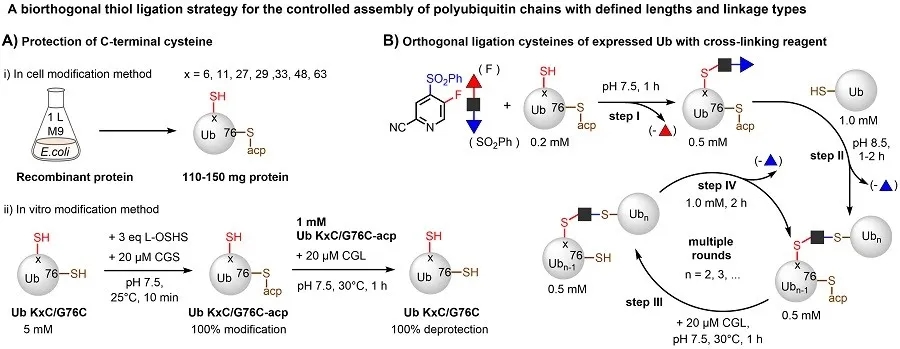
Figure 1. Strategy for ubiquitin C-terminal cysteine protection and deprotection combined with directional, controlled cascade thiol coupling using the FPPN reagent to construct polyubiquitin chains. Source: J. Am. Chem. Soc.
Using this platform, the team first constructed a series of isotope-labeled K48- and K63-linked ubiquitin chains and studied their structures by 15N-HSQC, chemical shift perturbation (CSP) analysis, and relaxation experiments (Figure 2). The FPPN-linked chains retain the overall conformational features and key recognition interfaces of natural chains: K48-linked chains remain compact, while K63-linked chains stay open, in close agreement with the natural counterparts. Protein-interaction studies further showed that the chemically constructed chains bind the ubiquitin receptor protein Rpn1 with binding modes and affinities similar to those of natural chains, indicating that the FPPN linkage preserves the canonical ubiquitin recognition surface.
Beyond preserving the main structural features, the FPPN linkage also confers excellent chemical and biological stability: it remains intact in high concentrations of GSH and in cell lysates, making it suitable for structural and functional studies in complex biological environments. It should be noted that this artificial linkage may introduce local structural perturbations near the junction, which could affect the binding of specific antibodies that depend on fine recognition of the linkage site and potentially influence recognition and cleavage by some deubiquitinases (DUBs).
The team further developed a spin-labeling strategy compatible with the assembly platform and constructed radical-labeled branched ubiquitin chains, enabling long-range conformational measurements by double electron-electron resonance (DEER). With this platform they studied the conformational behavior of K11/K48 and K48/K63 branched chains. In buffer, the branched chains populate a dynamic equilibrium of multiple conformations, whereas in cell lysates the conformational distribution of the K11/K48 chain shifts markedly toward more compact states (Figure 2). DEER experiments on the interaction between the K11/K48 chain and Rpn1 in different biological environments showed that Rpn1 stabilizes specific conformational states of the chain (Figure 2). These results indicate that the conformational state of a ubiquitin chain is dynamically regulated by the cellular environment, molecular crowding, and binding partners, offering a new structural perspective on how ubiquitin signals are recognized and transmitted in the cellular context.
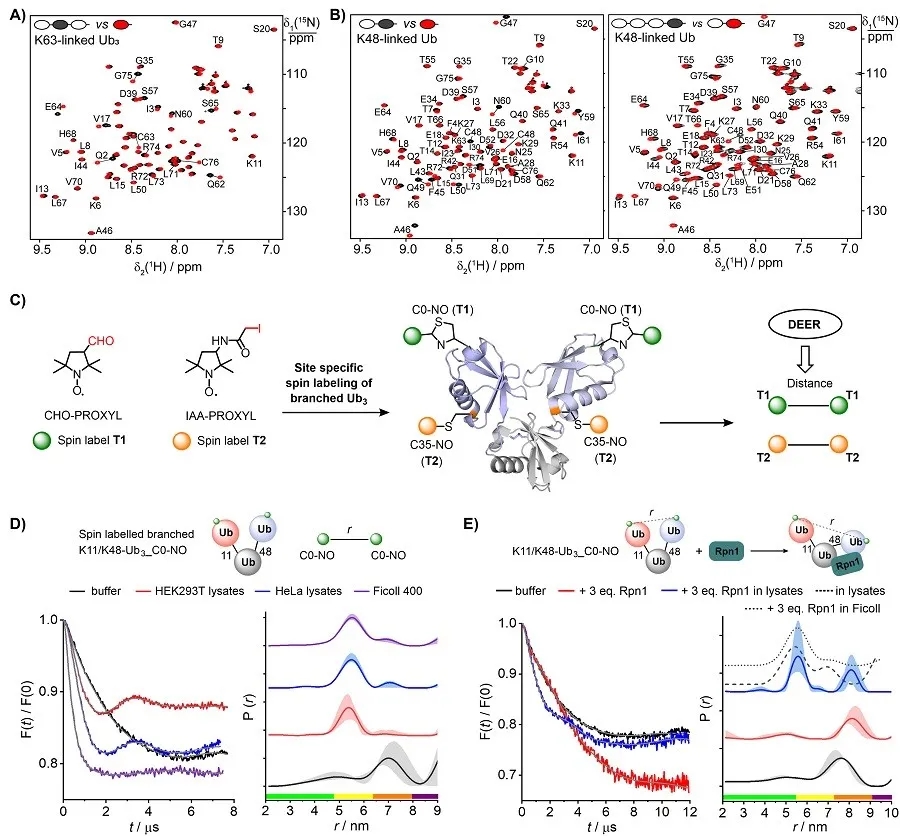
Figure 2. (A-B) 15N-HSQC analysis of FPPN-linked K63 and K48 polyubiquitin chains; (C-E) DEER characterization of radical-labeled K11/K48 branched ubiquitin chains in buffer, cell lysate, and crowded environments, and their conformational changes upon interaction with Rpn1. Source: J. Am. Chem. Soc.
In summary, this study establishes an efficient ubiquitin chain construction strategy compatible with functional modification, providing a new tool for the precise assembly of ubiquitin chains and for studying their dynamic conformations in cellular environments. It demonstrates experimentally that the cellular environment reshapes the conformational distribution of branched ubiquitin chains, offering a fresh view of how ubiquitin signals are transmitted under physiological conditions. In the future, the design and introduction of different linkers and functional probes, integrated with multiple biophysical techniques, should allow deeper dissection of the dynamic regulation of ubiquitin signaling in cells.
Professor Xuncheng Su of the College of Chemistry, the State Key Laboratory of Elemento-organic Chemistry, and the Frontiers Science Center for New Organic Matter at Nankai University is the corresponding author. Postdoctoral researcher Binbin Pan, graduate student Chi Zhou, and Distinguished Research Fellow Yin Yang are the co-first authors.
Paper Information:
Efficient and Controllable Assembly of Multitype Polyubiquitin Chains via Enzyme-Assisted Thiol Ligation for Structural Elucidation.
Bin-Bin Pan, Chi Zhou, Yin Yang, Xing Zhang, Chao-Yu Cui, Yang Li, Xun-Cheng Su*.
J. Am. Chem. Soc. 2026, DOI: 10.1021/jacs.6c04268


