To mark the centenary of the birth of Professor Xikui Jiang, the research group of Professor Tianfei Liu at the State Key Laboratory of Elemento-Organic Chemistry, Nankai University, was invited by Academician Kuiling Ding, Researcher Jinbo Hu, and Researcher Zhanting Li to write a review entitled "Chemical Pathways to the Origin of Life." It is the first comprehensive review on origin-of-life research published in China, and it also offers perspectives on the future search for extraterrestrial life. The article appeared on September 30, 2026 as a cover article in the Chinese Journal of Organic Chemistry (2026, 46, 3293-3316). Together with the companion article "Substituent Effects in Modern Radical Chemistry" by Professor Jindong Yang and Academician Jinpei Cheng of Tsinghua University (Chin. J. Org. Chem. 2026, 46, 3317-3327), it systematically reviews the progress made over nearly a quarter of a century since Professor Jiang received the 2002 National Natural Science Prize (First Class) for his work on two important aspects of physical organic chemistry: molecular aggregation and radical chemistry.
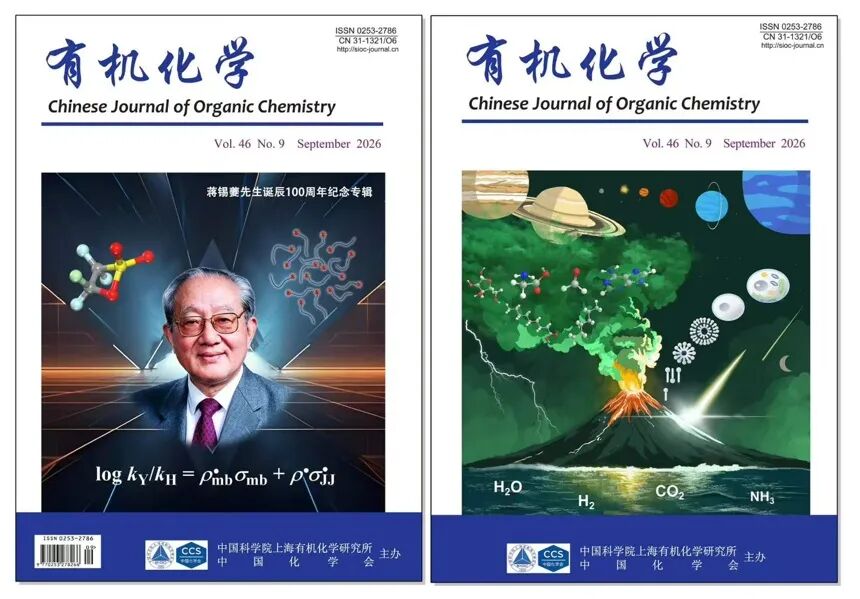
"Where does the universe come from, and why did life emerge? To the limited mind and wisdom of humankind, this may forever remain a beautiful and unfathomable mystery." So begins the preface of Professor Jiang's renowned monograph Aggregation and Self-Coiling of Organic Molecules. In recent decades, accumulating observations of the Earth and the deep universe have begun to provide key empirical evidence toward unveiling this grand picture, and the rapid iteration of experimental techniques has turned former thought experiments into practicable ones, gradually stripping the ancient puzzle of its mystery.
"Life is nothing but an electron looking for a place to rest with the help of a proton" (J. Am. Chem. Soc. 2021, 143, 560). The origin of life is one of the ultimate unsolved questions in the natural sciences, carrying both fundamental scientific depth and philosophical significance. With advances in deep-sea exploration, astrochemistry, and synthetic biology, the field is now moving from a hypothesis-driven stage toward an evidence-driven one. The review spans inorganic synthesis, organic self-assembly, thermodynamics, geology, and astrobiology, with the aim of charting the chemical path from simple inorganic molecules to protocells. It surveys prevailing views on the chemical evolution toward life, covering possible routes revealed by the analysis of deep-sea geological samples, deep-space observations, and laboratory simulations, and it describes how fatty acids, fatty alcohols, hydrocarbons, and nitrogen-, sulfur-, and phosphorus-containing organic compounds could have formed under early-Earth conditions. The review also presents recent progress on protocell theories and functional construction experiments based on the molecular aggregation and self-coiling theory developed by Professor Jiang and co-workers, together with work on the emergence of rhythmic and periodic ordered structures, self-replication and evolution, and assembly theory. It closes with a discussion of the last universal common ancestor and experimental attempts to build synthetic cells. The article is of considerable reference value and strategic significance for understanding early chemical evolution on Earth and for the exploration of extraterrestrial life.
Shanhui Zhu of Nankai University is the first author, and Professor Tianfei Liu is the corresponding author. The work was supported by the National Key Research and Development Program of China, the National Natural Science Foundation of China, the Major Science and Technology Program for State Key Laboratories of the Tianjin Municipal Science and Technology Bureau, and the Fundamental Research Funds for the Central Universities, with additional support from the State Key Laboratory of Elemento-organic Chemistry, the Frontiers Science Center for New Organic Matter, and the Tianjin Haihe Laboratory.
More information:
Chemical Pathways to the Origin of Life
Shanhui Zhu, Tianfei Liu*
Chin. J. Org. Chem., 2026, 46 (9): 3293-3316, DOI: 10.6023/cjoc202605021


