Recently, the research groups of Professor Chunfa Xu at the College of Chemistry, Fuzhou University, and Professor Tianfei Liu at the State Key Laboratory of Elemento-organic Chemistry, Nankai University, jointly published a paper entitled "Stereoselective Glycosylation of Amide with Glycal Catalyzed by a Solid-Liquid Phase-Transfer and Proton-Transfer Dual-Functional Pyridinium Catalyst" in the Journal of the American Chemical Society.
Glycosyl amides are important hybrid structures that link carbohydrates and peptides, and they play key roles in cell recognition, immune regulation, protein homeostasis, and drug development. Among them, 2-deoxyglycosyl amides can markedly improve the enzymatic stability and biological activity of glycopeptides, yet their chemical synthesis has long remained difficult: amide acceptors aggregate through hydrogen bonding and dissolve poorly, while the weak nucleophilicity of the amide nitrogen is kinetically mismatched with the oxocarbenium intermediate. Efficient and stereoselective synthetic methods are therefore scarce.
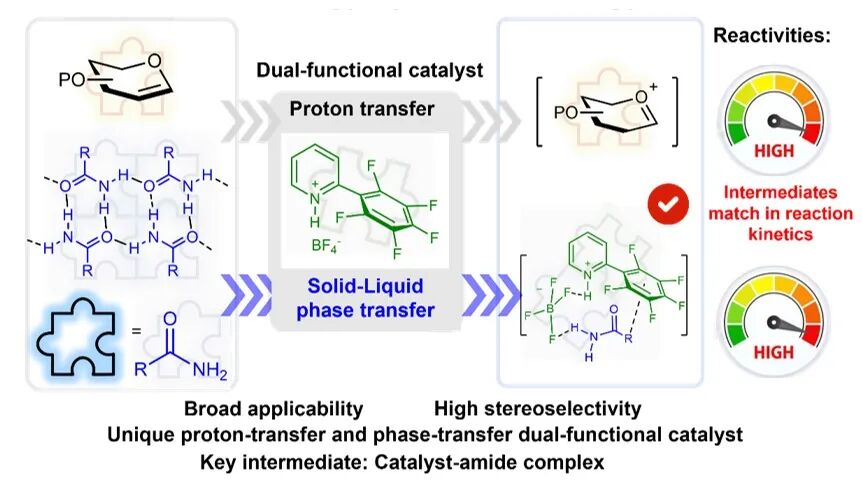
Figure 1. Schematic illustration of the dual-functional pyridinium-catalyzed 2-deoxyglycosylation of amides.
Inspired by the report that perfluorobenzene and benzene can form cocrystalline molecular complexes through specific π-π interactions (Nature 1960, 187, 1021), and building on their earlier finding that pyridinium catalysts can form bridging hydrogen bonds between the anion and phenolic glycosyl acceptors (Adv. Sci. 2024, 11, 2308513), the authors developed a phase-transfer and proton-transfer dual-functional catalyst, 2-pentafluorophenylpyridinium tetrafluoroborate. This catalyst resolves the kinetic mismatch described above and enables highly stereoselective glycosylation of amides with glycals.
A notable feature of this work is its broad substrate compatibility, good functional-group tolerance, and excellent β-selectivity. The Xu group showed that, beyond glucal and galactal, the method extends to rhamnal, xylal, and arabinal donors, and it accommodates a variety of aromatic and aliphatic amides. The reaction can be applied to the glycosylation of complex bioactive polypeptides, and it was used directly on peptides such as thyrotropin-releasing hormone (TRH) and a 15-membered cyclic peptide, greatly expanding the chemical space of 2-deoxy N-glycosyl amides.
Mechanistic elucidation, both experimental and theoretical, is another focus of this paper. The Liu group systematically characterized the key supramolecular intermediates by spectroscopic and spectrometric methods together with computational modeling, revealing the dual phase-transfer and proton-transfer functions of the new catalyst. They trapped and identified the main by-products, measured the reaction kinetics in detail, and established a Hammett correlation of the initial rate constants; the combined kinetic evidence and proton-transfer driving-force criteria (pKa values) allowed them to rule out implausible pathways. DFT calculations of the reaction energy profile further explained, at the molecular level, the origin of the high stereoselectivity.
This work offers new insights at the intersection of carbohydrate chemistry, fluorine chemistry, supramolecular chemistry, and physical organic chemistry, and it may prove inspiring to researchers in these related fields.
Qinbo Jiao (Fuzhou University) and Zhenbo Guo (Nankai University) are co-first authors of the paper. Professor Chunfa Xu of Fuzhou University and Professor Tianfei Liu of Nankai University are the corresponding authors. The work was supported by the National Key Research and Development Program of China, the National Natural Science Foundation of China, the Research Fund of Fuzhou University, the Major Science and Technology Program for State Key Laboratories of the Tianjin Municipal Science and Technology Bureau, the Fundamental Research Funds for the Central Universities, and the Open Fund of the State Key Laboratory of Advanced Fluorine and Nitrogen Materials, with additional support from the State Key Laboratory of Elemento-organic Chemistry, the Frontiers Science Center for New Organic Matter, and the Tianjin Haihe Laboratory.
Paper Information::
Jiao, Q.; Guo, Z.; Jiang, S.; Yan, W.; Zhai, S.; Chen, G.; Liu, T.; Xu, C.
Stereoselective Glycosylation of Amide with Glycal Catalyzed by a Solid�Liquid Phase�Transfer and Proton�Transfer Dual�Functional Pyridinium Catalyst.
J. Am. Chem. Soc. 2026, DOI: 10.1021/jacs.6c17350.


