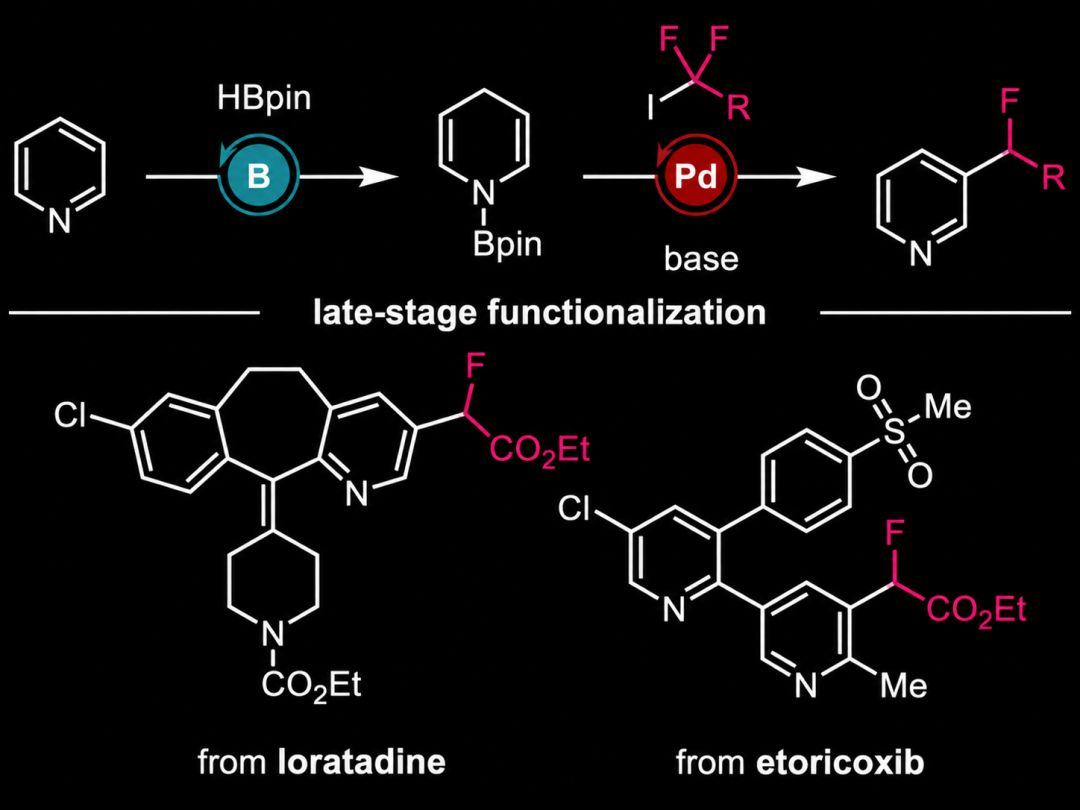
The research group of Xiao-Chen Wang at Nankai University reported a method for meta-selective C–H monofluoroalkylation of pyridines. By combining borane-catalyzed pyridine hydroboration with palladium-catalyzed radical difluoroalkylation, the method achieves direct functionalization at the meta position of pyridines. Using difluoroalkylating reagents as starting materials, the approach first introduces a difluoroalkyl radical into a dihydropyridine intermediate, which then undergoes defluorination and alkene isomerization to afford meta-monofluoroalkylated pyridines. The reaction is applicable to a wide range of pyridines and other nitrogen-containing heteroarenes, and can be used for the late-stage modification of drug molecules.
Highlights
1) Meta-selective functionalization of pyridines: borane-catalyzed pyridine hydroboration generates an electron-rich dihydropyridine intermediate, and the nucleophilicity of its β-position enables meta-selective addition of the difluoroalkyl radical to construct the C–C bond.
2) Monofluoroalkylation via a difluoroalkylation–defluorination cascade: starting from difluoroalkylating reagents, the reaction converts a difluoroalkyl group into a monofluoroalkyl group through radical addition, defluorination, and alkene isomerization. Mechanistic experiments detected the difluoroalkylated dihydropyridine intermediate and the alkene intermediate formed after defluorination, and radical-trapping and deuterium-labeling experiments further supported the proposed mechanism.
3) Broad substrate scope: the method is applicable to various mono-, di-, and trisubstituted pyridines, tolerating functional groups such as ester, cyano, halogen, and trifluoromethyl, and can be extended to quinolines, isoquinolines, and other nitrogen-containing heteroarenes. Various fluoroalkylating reagents also participate in the reaction.
4) Late-stage modification of drug molecules: the method was successfully applied to the monofluoroalkylation of various drugs and related molecules, including pioglitazone, loratadine, and etoricoxib. Some substrates could be prepared on a gram scale, and the resulting products could be further converted into monofluoromethyl or difluoromethyl derivatives through transformations such as decarboxylation and decarboxylative fluorination.


