Pesticides have always played an extremely important role in agricultural production, serving as an irreplaceable tool for preventing biological disasters, safeguarding crop production, and promoting sustainable and stable growth of agricultural products. However, their inefficient overuse and non-targeted effects have caused significant harm to the natural environment and non-target organisms. Although novel green pesticide delivery systems continue to emerge, their commercialization is often hindered by complex preparation processes, limited performance, and expensive raw materials. Nanogels possess many excellent properties, such as good biocompatibility and biodegradability, outstanding drug-loading capacity, and high stability, making them an environmentally friendly option for stabilizing active pesticide ingredients.
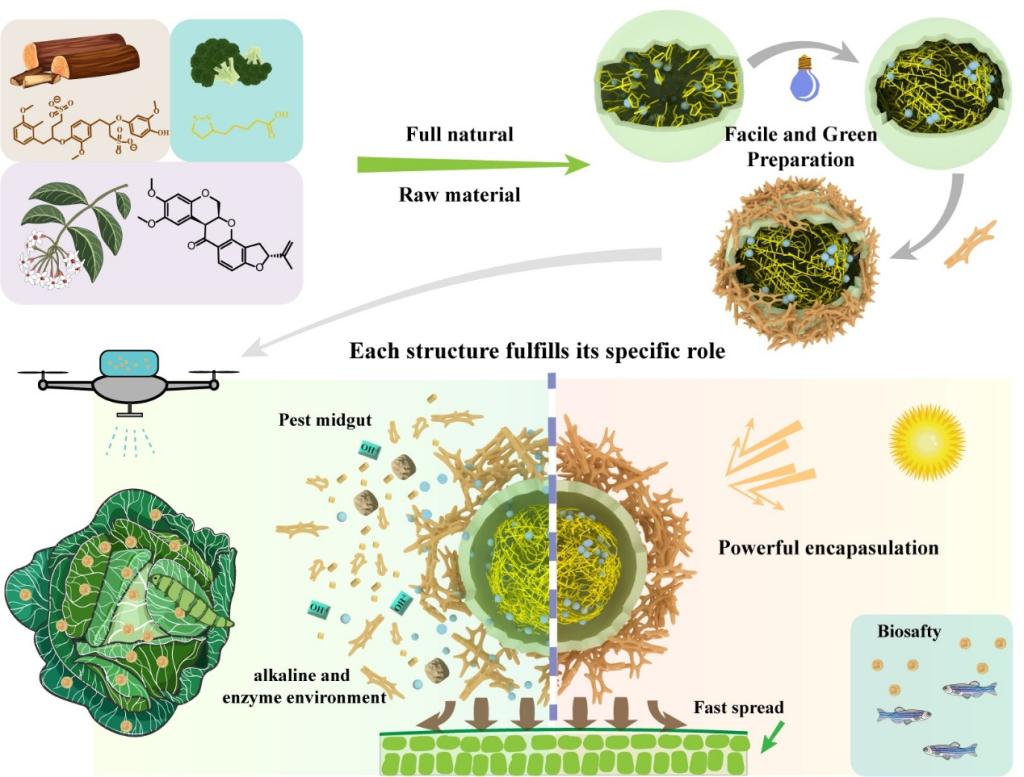
Recently, the Qingmin Wang research group at Nankai University developed a simple method for preparing RO-loaded hierarchically structured nanoparticles. First, photo-crosslinking was used to construct the nanoparticle core, which consisted of a three-dimensional network of dynamic covalent bonds, and iron (III) ions were introduced into the network to form strong complexes with the carboxylic groups of TA, replacing weak partial hydrogen bonds between TAs. Experimental results confirmed that formation of the internal gel network by photo-crosslinking improved the stability of the system. Second, the amphiphilicity of the natural product SL enabled its deposition at the oil–water interface of the nanogel through a self-assembly process, and iron ions were subsequently incorporated to form a mineralized outer shell. They assessed the effects of the amounts of the shell materials on the nanoparticle properties and determined the amounts for optimal performance. Ultimately, RO@(TA-Fe)/(SL-Fe)5 nanoparticles were found to exhibit the best performance and were chosen for further study. Release experiments showed that these nanoparticles released RO in response to both laccase and changes in pH, and the release mechanisms were explored. Experiments to assess the resistance of the nanoparticles to photodegradation demonstrated that their hierarchical structure enhanced the photostability of the encapsulated RO. Assessment of nanoparticle deposition and spreading on hydrophobic leaf surfaces allowed them to elucidate the effects of the shell structure on spreading and deposition. They found that droplets of nanoparticle dilutions spread faster than droplets of nanogel and showed increased deposition amounts. Furthermore, the nanoparticles exhibited biological activity that was superior to that of commercial formulations. Finally, biosafety evaluation—including tests of zebrafish toxicity, seed germination, and toxicity to human bronchial epithelial cells—confirmed that RO encapsulated in the hierarchically structured nanoparticles was significantly less toxic to nontarget organisms than commercial formulations. In summary, their easy-to-prepare hierarchically structured nanoparticles exhibited excellent performance and good biological safety, and their findings provide valuable insight that may lead to the construction of novel, intelligent pesticide-delivery systems for sustainable agriculture. Relevant achievements were published in Chem. Eng. J. 2025, DOI: 10.1016/j.cej.2025.171432.


