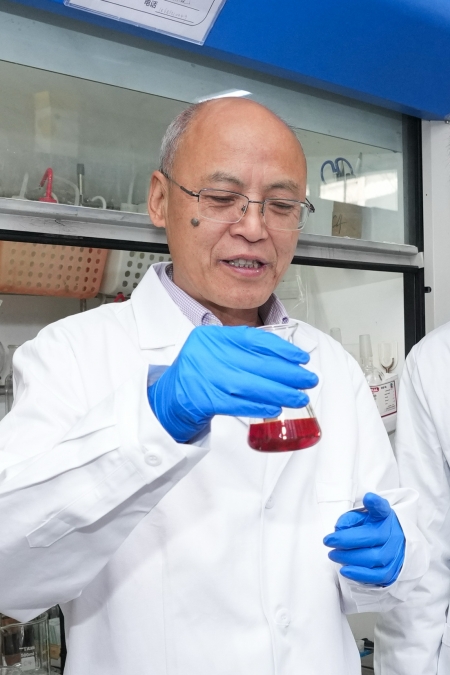
In a modest office on the east side of the fifth floor of the Min Wei Hall at Nankai University, Yongsheng Chen is attentively listening to the weekly research reports of two students from his group. A man of few words, he quickly identifies the core scientific issues, offering rigorous guidance while never withholding encouragement. As the students leave the office, their brisk steps and unconcealed smiles reflect their joy at having their work recognized.
Casual attire, a pair of sneakers, and a red hand-knitted sweater—this has become Professor Yongsheng Chen’s signature look in the eyes of colleagues and students alike. Not long ago, when confirmation arrived from Beijing that he had been elected an Academician of the Chinese Academy of Sciences, Chen continued his routine as usual, arriving early at the laboratory to discuss research challenges with his team. His goal remains unchanged: to make organic solar cells greener, more efficient, and more cost-effective, and to overcome bottlenecks that limit the large-scale application of flexible organic photovoltaic devices in everyday life.
From a rural youth in Wen County, Henan Province, to an internationally renowned polymer and materials chemist; from studying at Nankai in pursuit of knowledge to returning to his alma mater with a deep sense of national responsibility—Yongsheng Chen’s journey has never followed an easy path. What has sustained him are an unwavering commitment to serving the nation through science and a relentless spirit of innovation. For more than two decades, with organic solar cells as his focus and green energy as his compass, his work has remained closely aligned with China’s progress in energy science and materials technology.
From an Unpopular Choice to a Global Research Frontier
“Using science and technology to support national development is a mission that every researcher must shoulder,” Chen reflects, even twenty years after his decision to return to China. “Supporting the development of my alma mater is my duty.”
After earning his bachelor’s degree in chemistry from Zhengzhou University in 1984, Chen was admitted to the College of Chemistry at Nankai University for his master’s studies. His three years at Nankai laid a solid foundation for his scientific career. After graduation, he taught Organic Chemistry at the University of Science and Technology Beijing. A few years later, no longer content with a career limited to teaching, he decided to pursue advanced studies overseas. Leveraging his rigorous scientific foundation and pioneering spirit, he continued to deepen his expertise in the field of polymer materials. Years later, despite securing a position at leading international research institutions, Chen became increasingly aware of technological restrictions imposed on China. What shocked him most was that research projects he personally led were sometimes inaccessible to Chinese institutions.
In 2003, as Nankai University was preparing to plan and establish a materials research platform, it sent a sincere invitation to Yongsheng Chen, who was then overseas, hoping that he would return to China and participate in its construction. At the same time, Yongsheng Chen also deeply felt the historic leap in the country’s research ecosystem over the past decade: not only had scientific instruments gradually become more complete, but there was also a broad fertile ground that allowed scientists to explore independently and transform their talents into driving forces for national development. “I was born in the countryside. When I was young, there were many children in my family, and our financial conditions were relatively difficult. After graduating from junior high school, I did not have the opportunity to attend high school. I dropped out for a period of time and even helped the commune make tofu and sell tofu. It was with the encouragement and support of my uncle and my second aunt that I resumed my studies, and my life was changed from then on. Years of experience have made me more clearly realize the importance of scientific and technological talent to a country’s development.” With a sincere sense of mission to help his alma mater take off and to devote himself to building a strong country, Yongsheng Chen resolutely gave up generous overseas opportunities and returned to China without hesitation.
After rejoining Nankai University, Chen gradually built a research team focused on carbon-based green energy materials and applications. In 2007, his group began research on organic solar power generation and carbon-nanomaterial-based energy storage.
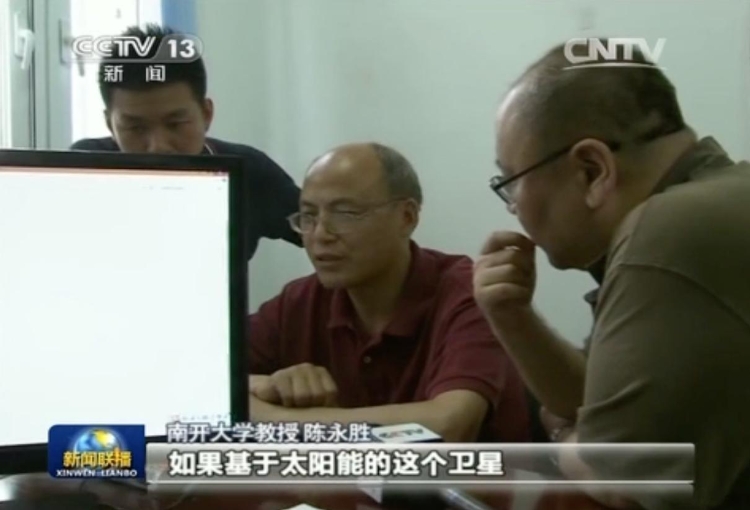
In June 2015, CCTV News reported the team’s breakthrough in large-scale, directly light-driven graphene materials, achieved in collaboration with Professor Jianguo Tian.
At the time, the organic photovoltaic field was at a low point, with power conversion efficiencies around 5%. Many researchers lacked confidence in its future and withdrew from the field. Meanwhile, graphene research in China was still largely undeveloped. Chen’s decision was widely regarded as risky.
“Most international teams focused on traditional polymer active materials,” Chen explained. “Continuing along that path would have been safer, but unlikely to yield distinctive or breakthrough results.” His goal was always to develop organic photovoltaic materials and technologies with independent intellectual property rights and secure a leading position globally.
Relying on his keen insight into the field and prudent analysis, Chen decisively chose the then high-risk and highly challenging new solution-processable organic small-molecule and oligomer active materials as the main breakthrough point for his team’s solar power generation research.
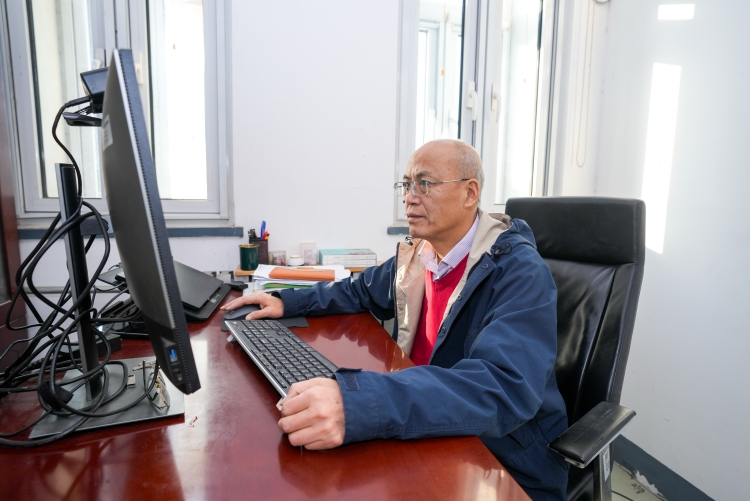
From molecular design to device fabrication and optimization, he led his team in relentless experimentation. After more than a decade of sustained effort, they established a distinctive oligomer-based organic solar cell material system.
From an unpopular research direction to the forefront of international science, Chen and his team achieved breakthroughs that not only strengthened China’s position in green energy research but also exemplified the mission of “writing scientific papers on the soil of the motherland.” Their work provided China with a strategic advantage in global competition over new energy technologies and contributed Chinese solutions to sustainable development worldwide.
Serving the Nation Through Independent Innovation
Bringing “Sunshine” Into Reality
Scientific research has no final destination—only ever-higher peaks to conquer.
In 2017, Chen Yongsheng’s team constructed tandem organic solar cells using a complementary light-absorption strategy based on oligomer materials, achieving a power conversion efficiency of 12.7%, setting a world record at the time, and being selected as one of the “Top Ten Optical Advances in China in 2017.” Facing the honor, Chen Yongsheng looked further ahead: “Next, we will mainly address the issue of device lifetime and further improve the energy conversion efficiency. We believe that the dream of organic solar cells truly moving from the laboratory to practical applications and realizing commercial production will become a reality in the near future.”
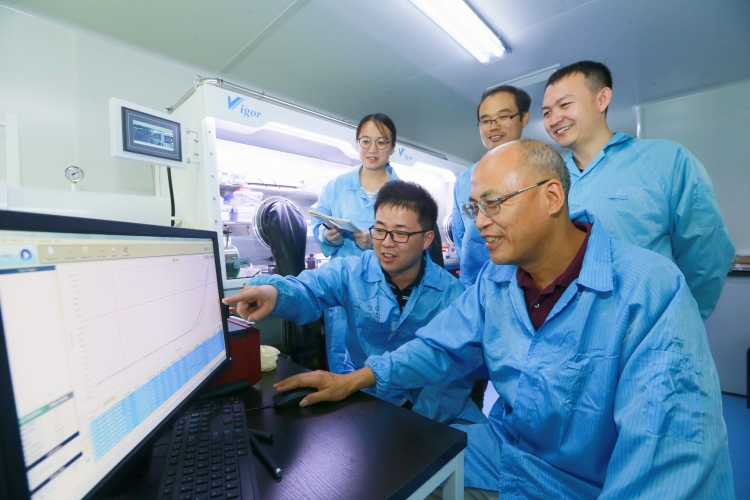
In 2018, even more exciting news arrived. The tandem organic solar cell materials and devices designed and fabricated by the team achieved a power conversion efficiency of 17.3%, once again setting a new world record. This achievement was published in the top international academic journal Science, pushing research on organic solar cells to a new height.
Progress has continued unabated. From an initial 5% to over 20% efficiency today, Chen’s work has significantly boosted confidence in organic solar cells. His team’s design concepts and structural units have been widely adopted, enabling China to lead global research and development in this field.
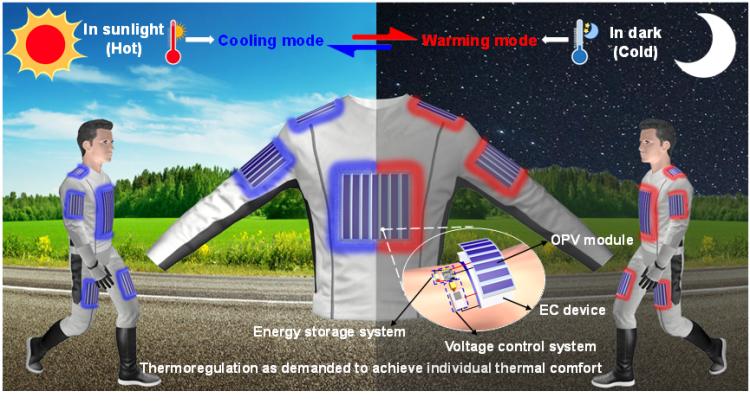
Schematic diagram of the working principle of an all-weather, self-sustaining human thermal management garment driven solely by sunlight
To meet evolving application demands, Chen expanded research into practical scenarios for organic photovoltaics. His team developed a novel energy-self-sustaining human thermal management system based on flexible organic photovoltaics and polymer electrocaloric devices, enabling bidirectional active thermal regulation. Speaking of the original intention behind this research, Chen outlined a moving vision: “If we can achieve cooling under the sun and warmth at night, and if we can use the infinite and ubiquitous solar energy to realize the all-weather, self-sustaining human thermal management described above, the living space of humankind will be greatly expanded.”
In addition, drawing on years of experience in polymers, carbon nanomaterials, and related fields, Chen led his team in developing proprietary “dry electrode” technology and its large-scale manufacturing processes, breaking foreign monopolies and achieving large-scale application in key areas such as power grid frequency regulation and peak shaving, rail transit, and specialized power supplies. “In the competition in the critical field of green energy, we must strive to provide the country with complete technological solutions that are independent, self-reliant, and internationally leading,” Chen said. “China is a country with a large population, and no industry or field can rely on others. Every sector must possess its own independent technologies. In strategic areas such as new energy and core materials, reliance on others is even less an option. As researchers, we must shoulder this responsibility.”
A Code of Conduct” Passing on the Torch of Scientific Endeavor
The “Three Commitments” Bearing Witness to an Educator’s Original Aspiration
Beyond scientific research, Chen places even greater emphasis on talent cultivation. As a mentor, in addition to guiding students in research, he attaches great importance to the development of their character and moral integrity.
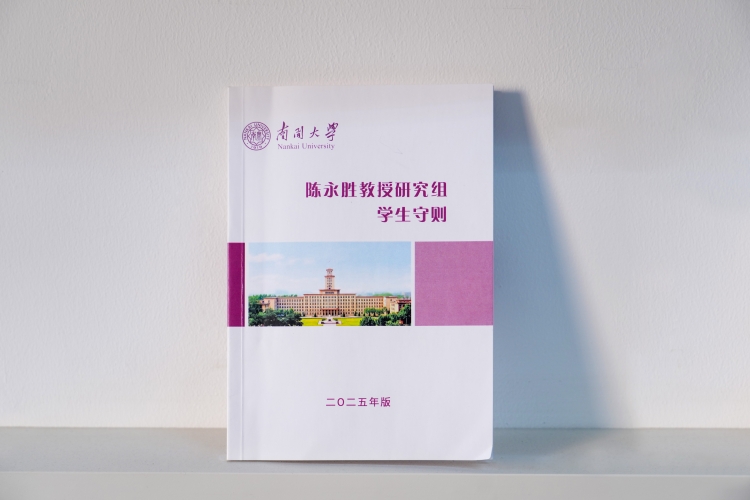
Within Chen’s research group, a student handbook accompanies students from the moment they join the group until they complete their studies. This Student Code of Conduct of Professor Yongsheng Chen’s Research Group, revised and updated annually, begins by setting out Chen’s most fundamental expectations for the team: “the three essential principles in conduct and action—responsibility, determination, and perseverance.” Between its lines are earnest reminders such as “safety comes first, and one must learn how to conduct oneself before undertaking work,” as well as warm guidance including, “remember that any small good habit, if maintained over the long term, will produce significant positive results.” Through continuous revision year after year and transmission from one generation of students to the next, it has become a spiritual guide nurturing both scientific innovation and character formation within the group.
To his students, Chen is both a rigorous academic mentor and a compassionate life guide.
“Professor Chen’s rigor and meticulousness in academic work, and his careful, word-by-word revisions of students’ papers, taught me what true responsibility really means.” Growing from a student in Chen’s research group into a doctoral supervisor, Bin Kan, a young faculty member at the College of Materials Science and Engineering, has always been deeply grateful for his mentor’s guidance by example. It was precisely Professor Chen’s unwavering determination to see things through that taught him to face difficulties head-on and never give up, and further strengthened his resolve to follow in his mentor’s footsteps, embarking on a path of teaching, educating students, and serving the nation through scientific research.
When students face financial hardship, Yongsheng Chen consistently offers quiet support and generous assistance, doing everything he can to relieve their worries so that their steps on the path of learning are no longer burdened and they can devote themselves wholeheartedly to research and study. Over the years, he has helped illuminate the educational journeys of many students in difficult circumstances as they pursued their dreams.
Without needing to speak for itself, virtue draws people to it. Students trained by Chen are now spread across the country, with many having been selected for national-level talent programs and becoming backbone forces in university research and enterprise-driven innovation.
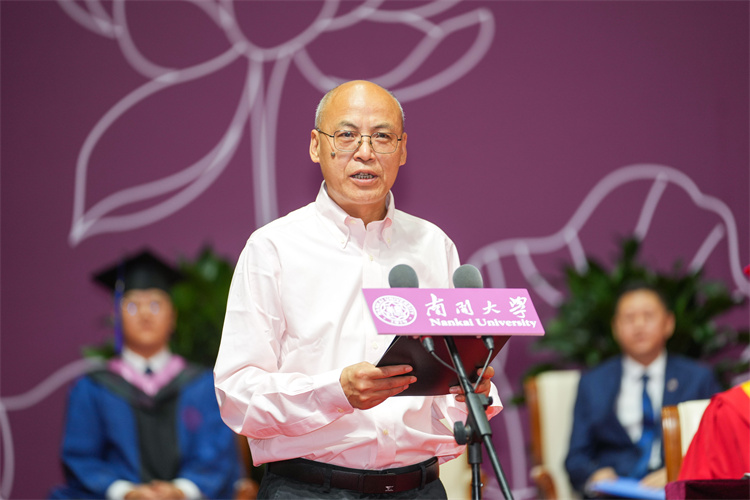
“You are a fortunate generation and the true elite entrusted with great expectations. You should be rooted in your own families while integrating yourselves into the greater whole; maintain a lifelong commitment to learning and refrain from complaining when things do not go your way; always remember that effort is rewarded, cherish your youth, never forget the education of your alma mater and the care of your parents, and contribute to the building of a strong nation and the great cause of national rejuvenation.” At the graduation ceremony, speaking as a faculty representative, Chen expressed his deep expectations for the young students. These words were not only heartfelt hopes for the next generation, but also a vivid reflection of his decades-long dedication to scientific research, advancing China’s polymer science and energy technology through steady, incremental breakthroughs.
Rooted at Nankai University for more than two decades, Chen Yongsheng has received numerous honors, including the Second Prize of the National Natural Science Award and the First Prize of the Tianjin Natural Science Award. He was selected among the first group of Tianjin Distinguished Talents and was honored as a Tianjin Model Worker, an Outstanding Science and Technology Worker of Tianjin, and an Outstanding Teacher of Tianjin. As Chief Scientist, he has twice led projects under the National Key Research and Development Program.
Despite being laden with honors, Chen Yongsheng has consistently maintained a humble, low-key, and meticulous style, devoting all his energy to scientific innovation and talent cultivation. Every morning, he walks to the laboratory early to carefully guide students and discuss experimental plans; he also travels to partner enterprises in the Tiankai Higher Education Science and Innovation Park to conduct on-site investigations into challenges in research commercialization, building bridges for deep integration among industry, academia, research, and application.
“Being elected an academician is an honor, but even more a responsibility.” Standing at a new starting point, Chen requires himself and his team to work harder, remain more humble and prudent, focus more closely on the core scientific issues of their research field and the nation’s major technological needs, further promote the translation of more research results into practical applications, cultivate more outstanding young scientific talents, and contribute greater strength to China’s independent innovation and sustainable development in energy science and technology.

